After reading the article by Ann Friedman on interviewing I feel much more confident the next time I do an interview. However, one question I had was how does one necessarily “embrace the silence”? This seems quite difficult in a sense that silence in an interview seems completely awkward, I have been in several interviews myself and every time there is a long pause of silence things just get awkward. Possibly better advice I feel would be how to not have silence, or how to recover from an awkward pause. This reminded me of this quite hilarious scene from The Office that plays with the idea of silence.
Category: Uncategorized
Lighting
I thoroughly enjoyed the Lighting Tutorial Including 3 point lighting and more video from Blind Spot Gear. The video gives a brief overview of some different types of lighting in film and provides great visual examples to explain them. Being a predominantly visual learner myself this video does a great job of not only explaining the different types of lighting, but showing accurate examples. One question that I had while watching this video was how the difference between natural lighting and man made lighting would affect visuals? Although the video shows both types of lighting he does not go in depth into explaining and showing this.
While watching this video I began to think of examples in films that I watch and how the lighting might have affected these without me ever realizing it. The first film that came to mind was The Blair Witch Project which is shot in natural lighting and with the aid of some flashlights and the camera’s night vision mode. This lighting allows the film to appear as the director intended it to be a type of found footage documentary. The low lighting and almost completely dark aspects of the movie really help play on the viewers’ sense of fear.

Another film that I thought of while viewing this video was 2001: A Space Odyssey. This film uses lighting in many different ways, from using extremely bright lighting to to kind of bring out the aspects of a high tech futuristic environment. There are other scenes where the scene is almost entirely red which helps intensify the scene. These types of lighting usually help set the scene and give the movie its unique high-tech feel.


Photo Scavenger Hunt


ds106 random album cover

Lenses
When reading the Van Sijll chapter on camera lenses I was opened up to a lot of things that I never normally think about while watching films. While watching movies I never really think about the shots and the types of lenses that are being used in particular scenes and for particular reasons. Sijll does a great job of explaining many different lenses and shots and the reasons behind them.
One question that came to mind when reading the section was why exactly do certain directors choose certain angles and lenses for certain scenes? I know that this section explains in detail what certain lenses and shots are used for to get different dramatic affects, however I wonder how certain directors such as Tarantino or Kubrick go about picking these shots to get an emotional response from viewers without them ever even realizing it. I guess this would be tough to answer as a whole and you would have to ask almost every director individually, but this reading definitely makes me wonder.
Another thing I thought of while reading this chapter came from my own personal experience not with cinematography, but from shooting amateur photography myself for about the past year. I started off simply taking pictures on my iPhone and slowly upgraded to my own DSLR with several different types of lenses. I kind of started learning about them by just experimenting myself and seeing how these lenses worked at different angles and what they did exactly. After reading this chapter I have gained a lot of knowledge about the use of these different lenses and how I personally might use them better.
While reading this chapter I also began to think about the shots in some of my favorite movies. The first thing that I thought of was the police lineup scene in The Usual Suspects. It is a very unique scene in that it is shot from the point of view of police behind protective glass interviewing suspects in a case that they are trying to solve. There are not many scenes in film that are shot in this exact perspective and that is part of the reason that this scene has become so iconic to the movie and to the film industry itself. I also though of a movie that I had watched last year called Tangerine. This film is an interesting film in many ways, but one of the parts that makes it most interesting is that it is shot entirely on three iPhone 5s phones. This gives the film a very gritty and real feel to it that you do not get in many other movies or tv shows.

Our Visual Age
In reading the article “As We Become Cameras” by Matt Hackett there were several things that stood out to me. Hackett writes, “We are approaching a world in which visual and auditory presence at a distance—seeing as another, instantly—is not a rare luxury good, but a basic assumption of society and industry. The superpower of unbounded remote vision is becoming mundane.” I agree with this assumption, but at the same time I think that it is pretty proud in the sense that he talks as if it is happening sooner rather than later. I wonder how soon Hackett actually believes that this “infinite vision” society will be unlocked? Although it is currently much easier to take and share pictures, even more so than 10 years ago even, I wonder if humans will eventually hit a wall with this image sharing technology.

All of this talk about wearable cameras that would be able to take and broadcast photos almost effortlessly sounded somewhat like an episode of Black Mirror to me. If anything that we saw on a a daily basis could be recorded and sent out without the person being recorded knowing, this is a scary scene. For example on the Black Mirror there are several episodes that involve humans having the ability to record everything or see what other people are seeing as it is happening to them. As you can imagine with these being Black Mirror episodes, most of these scenarios do not turn out the greatest. I fear that if picture taking and sharing capabilities become any greater than they currently are then these nightmares may in fact become a reality.
Another example that came to mind when reading this article was the idea of virtual and augmented reality. I wonder how long it will be until virtual and augmented reality become an everyday part of our lives. I feel like the rise of how we can take and distribute pictures has somewhat of an impact on this as well. Maybe one day technology will become so advanced that we will not be able to tell a picture taken in virtual reality from a picture taken in real life.
Something Funny Happened
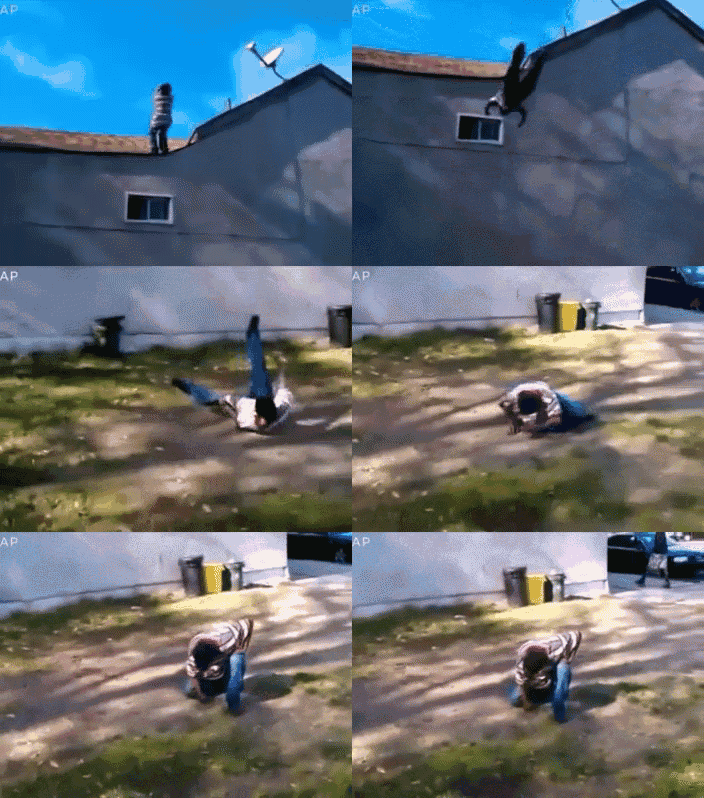
In high school my friends and I used to sneak up to our school and climb on the roof at night. We wouldn’t really do anything bad, we just felt pretty rebellious being able to climb on top and not get caught. Looking back now this probably wasn’t the smartest idea. One night we climbed on the roof and started running around the entire school like sort of an obstacle course. All of the sudden we saw a car pull into the parking lot and it was our principal’s car. We didn’t have time to hide so we basically just went to the lowest point possible and jumped off without even thinking about landing (which hurt like hell). We started to make a run for it when we realized that it was just the principal’s son driving his dad’s car. He called us idiots because he saw us and then parked the car and joined us in getting back on the roof.
Digital Storytelling
As I read the chapter on digital storytelling in the 21st century by Bryan Alexander I was immediately reminded of the many digital stories that I have read or listened to in my life. The first example that came to my mind were the many great stories that I have read on Reddit that come from subreddits such as r/writingprompts or r/nosleep. Both of these subreddits contain a vast amount of digital storytelling, with most of these stories coming from anonymous or amateur writers who are not using their writing to gain any fame or fortune, but to simply tell a story. Before I subscribed to these subreddits I did not see myself as someone who necessarily liked to read stories. However, afterwards I find myself lying awake many nights reading short story after short story until I can no longer stay awake.
Another example of how digital stories affect me in my everyday life that I never really thought of until reading this chapter come in the form of Netflix and YouTube. I am always watching YouTube videos on simply random topics ranging from sports videos to conspiracy theories. However, I never really thought of these as having any components of stories to them. Now that I look at it however, there are many stories on YouTube that I love. Conspiracy theory videos being one of them. They always start with a beginning, usually come to a peak explaining the crazy and sometimes scary conspiracies that people conjure up, and close out with reminding the viewers that these are just theories and that they might not even be true. Just like a good story these videos keep viewers, myself included, deeply enthralled in the narrative without even thinking about how much time has passed.
One question that came to mind when reading Alexander’s chapter was the fact that he considers Presidential elections as a form of storytelling. Alexander writes, “It is now commonplace to view Obama’s successful campaign as a a mythopoeic story, where a heroic figure journeys through trials, ultimately arriving at triumph.” I see where he is coming from when he writes this. However, I would disagree in the fact that someones life and journey through life is not actually a story in itself, but could later be turned into one. For example, if someone were to make a documentary or write a book about Obama’s journey to the White House then that would make it a story. I do not think that someone simply living their life and doing great things should be considered a story until it is turned into one.

 Dalton Jones Blog
